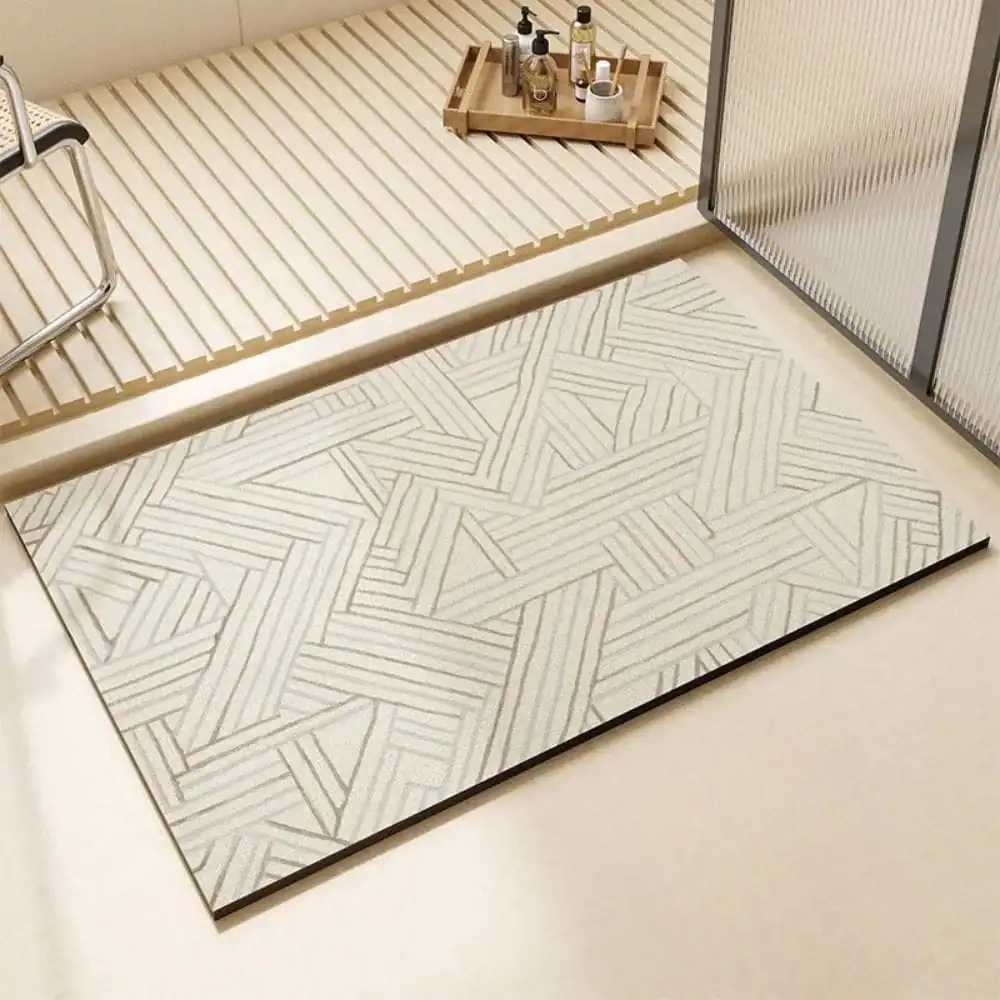
A “stone” bath mat is usually not cut stone at all. Most are slabs made from diatomaceous earth, also called diatomite, a natural material with a very fine pore structure. The short answer to how they work: water from your feet is drawn into those pores instead of sitting on the surface, and it then leaves the slab by evaporation.
That is the principle. How well any given mat does it, how long it keeps doing it and how it should be handled are separate questions, and the sources do not all agree. This guide sticks to what geological surveys, government agencies and testers have actually published, and flags clearly where a statement only comes from manufacturers.
- 01What diatomaceous earth is
- 02How the mechanism works, step by step
- 03What independent testers found
- 04The 2020 to 2021 asbestos recalls in Japan
- 05Caring for a diatomaceous earth mat: what manufacturers say
- 06How it compares with fabric and wooden mats
- 07Quick quiz: stone bath mats
- 08Checklist if you own a stone bath mat
- 09Frequently asked questions
- 10Sources
What diatomaceous earth is
Diatomite is a sedimentary rock. The United States Geological Survey (USGS) describes it as made of accumulated silica from the cell walls of dead diatoms, which are microscopic algae living in oceans and fresh water. The USGS also confirms that diatomite and diatomaceous earth are two names for the same material.
The properties that matter for a bath mat are listed by the USGS National Minerals Information Center. According to that page, diatomite is:
- very finely porous
- very low in density, to the point of floating on water at least until it is saturated
- essentially chemically inert in most liquids and gases
- low in thermal conductivity
Bath mats are a tiny niche for this material. In its 2026 Mineral Commodity Summary, the USGS reports that about 60% of the diatomite produced in the United States goes into filtration products, and the remaining 40% into absorbents, lightweight aggregates, fillers and other uses. The same summary notes that Canada was the largest source of US diatomite imports from 2021 to 2024.
Geology.com, in an article by geologist Hobart M. King, adds that dry diatomaceous earth can absorb and hold an amount of liquid equivalent to its own weight. That figure describes the raw material, not a finished bath mat, which is a pressed slab that may contain other ingredients.
How the mechanism works, step by step
Put together, the sources describe the same basic sequence:
1. You step onto the slab with wet feet. 2. Water moves into the fine pores of the material rather than staying on top. Consumer Reports describes these mats as compressed slabs of diatomaceous earth “with millions of pores that soak up water and keep the surface dry.” 3. The water held in the slab then evaporates into the room air. Dorai, a manufacturer, explains on its “how it works” page that the stone draws moisture away from the surface and releases it into the air.
Two points are worth keeping in mind.
First, the speed depends on the room. Evaporation needs air that is not already saturated, so a small bathroom with no window and no running fan gives the water fewer places to go. No source we opened gives a measured drying time for a mat in real bathroom conditions.
Second, a finished mat is not pure diatomite. Dorai, for example, describes its core material as a blend of diatomaceous earth and paper. Composition, density and thickness vary from one product to another, so the behaviour of the raw rock does not automatically carry over to every mat.
What about the drying times you see in ads
Manufacturers publish very confident timings. Dorai’s own page says its mat “pulls moisture away in seconds,” is “dry again within minutes” and “dries in under 60 seconds.” These are manufacturer claims. We did not find an independent, published measurement that confirms a specific number of seconds or minutes, so this guide does not repeat any figure as fact.
What independent testers found
Consumer Reports
Consumer Reports published a review of stone bath mats, updated March 4, 2026, written by Shalwah Evans. In the part of the article that is publicly visible:
- Five diatomaceous earth bath mats were tested, including models from Dorai, Medusa, Slipx Solutions and Sutera.
- The writer used each one for a week at home, in the same way she uses her regular shower rug.
- José Amézquita also tested the same mats in the lab at CR’s headquarters in Yonkers, New York, “to find out how easily they break,” because the mats are, in CR’s words, “somewhat fragile.”
- Four of the five mats were judged efficient enough at drying feet, and at air drying afterwards, that the writer said she did not think she could go back to a traditional rug. The fifth did not make the list of picks.
- The “big drawback,” according to CR, is that they “can crack if mishandled or dropped.”
- CR advises checking, before buying, that a mat is made of food-grade or cosmetic-grade diatomaceous earth.
- On lifespan, CR quotes a design consultant, K. Turner Temple, who says that mats manufactured and used responsibly “should last for a few years.”
The lab break results, the individual ratings and CR’s sections on safety and cleaning are reserved for members, so we cannot report them here.
Other hands-on reviews
Lighter reviews point in the same direction, with the same limit: comfort. A Bob Vila editor who tested a diatomaceous earth mat on video found the absorbency impressive but said it is “not very soft” and lacks a spa feel. An AOL reviewer who used one for a month with her family listed “not soft and plush” as a downside. Neither review measured drying time, slip resistance or breakage.
The 2020 to 2021 asbestos recalls in Japan
This is the part brand blogs tend to skip, and it is the most important one if you own an older mat.
What happened
According to a May 18, 2021 briefing document from Japan’s Ministry of Health, Labour and Welfare (MHLW), the problem first surfaced in November 2020 with diatomaceous earth bath mats and coasters made in Japan that contained more than 0.1% asbestos by weight. Investigations then found the same issue in diatomaceous earth bath mats sold by large home centres and other retailers. According to the MHLW Fukuoka Labour Bureau, products containing asbestos above the 0.1% threshold have been banned in Japan since September 1, 2006.
The MHLW had the sellers announce the affected products, published the lists itself, asked people to stop using them immediately and instructed the companies to recall all units. The ministry also noted that some products recommended regular sanding with a file or sandpaper to keep them absorbent, and that sanding could release asbestos. The recalls were carried out in coordination with Japan’s Ministry of Economy, Trade and Industry and its Consumer Affairs Agency.
The city of Inagi, in Tokyo, keeps an English summary of the MHLW announcements:
| Announcement date | Seller or importer | Products named | |—|—|—| | December 15, 2020 | Cainz Co., Ltd. | Diatomaceous earth bath mats and other items | | December 22 and 25, 2020 | Nitori Holdings Co., Ltd. | 7 types of coasters, 2 types of bath mats and other items | | December 28, 2020 | Fuji Trading Co., Ltd. | 11 types of bath mats | | January 15, 2021 | Fuji Trading Co., Ltd. (importer), Watts Co., Ltd. (seller) | Bath mats and draining mats, 4 types | | January 29, 2021 | KMJ and JASKIVI, sold on amazon.co.jp | Diatomaceous earth bath mat, 40 cm x 30 cm x 0.9 cm, grey, engraved JASKIVI |
Source: City of Inagi, summary of MHLW announcements (updated February 2, 2021).
What Japan changed afterwards
Following these cases, the MHLW amended its asbestos rules. Since December 1, 2021, anyone importing diatomaceous earth bath mats, coasters, trays and similar board products into Japan for sale must obtain an analysis report showing they contain no more than 0.1% asbestos. Since August 1, 2021, a manufacturer or importer that learns a product contains more than 0.1% asbestos must report it to the local labour standards office.
The official handling advice
Japanese authorities gave consistent advice for the affected products:
- As long as the bath mats and coasters are used in the normal way, asbestos is not expected to be released and no health problem is expected, according to the Fukushima Prefecture page and the Inagi summary.
- Do not sand, cut or break them, because that may release asbestos fibres.
- If a mat is already damaged and you are worried, the MHLW advice relayed by Inagi is to put it in a plastic bag, seal it securely with tape and keep it until collection.
- Do not throw it out with household garbage. Ask the seller or manufacturer to collect it, and contact your municipality if the seller is unknown.
For you, the practical rule is simple: if you have any doubt about where a diatomaceous earth mat comes from, do not sand it, do not try to break it up for disposal, and check with the seller first.
And in Canada
Canada has its own rules. Environment and Climate Change Canada and Health Canada explain that the Prohibition of Asbestos and Products Containing Asbestos Regulations ban the import, sale and use of processed asbestos fibres. Their guidance treats amounts below 0.1% as trace amounts, and states that human health risks from exposure to trace amounts of naturally occurring asbestos are expected to be low. We did not find a Canadian recall specific to diatomaceous earth bath mats. To check a product, the Government of Canada recalls and safety alerts site (recalls-rappels.canada.ca) is the official place to look.
A separate point: crystalline silica
The USGS adds a general caution in its 2026 summary: many forms of diatomite contain crystalline silica, which is known to cause cancer, birth defects or other reproductive harm when people are exposed to levels above permissible limits. That warning concerns the processing and use of the raw material, but it is one more reason to avoid creating dust from a mat at home.
Caring for a diatomaceous earth mat: what manufacturers say
Care advice comes almost entirely from manufacturers, and it is not consistent. Treat the points below as “manufacturers say,” and follow the instructions that came with your own mat first.
Cleaning
- Mophonic recommends wiping the mat with a damp cloth weekly to remove dust, lint and soap residue, using mild soap if needed, then rinsing well and letting it dry fully.
- Mophonic also says not to soak the mat for long periods and not to use bleach, waxy cleaners or oily products.
- Dorai, on the other hand, tells owners to wet its bath stones, apply a mild liquid soap or gentle household cleaner, scrub with an abrasive sponge or brush and rinse, about once a month.
So one brand advises against soaking and another has you wet the stone fully. These products are not all made the same way, which is why the instructions that came with your mat should take priority.
Oils and residues
Mophonic advises keeping soap residue, oils and heavy lotions off the surface when possible. Dorai notes that, because the material is porous, oils can leave rings and cause minor discolouration. That is consistent with the mechanism: anything that coats or fills the pores leaves less room for water.
Sanding
Several brands suggest sanding to remove stains or restore absorbency. Mophonic mentions fine-grit sandpaper. Dorai mentions medium-grit sandpaper for deeper stains and asks owners to do it in a well-ventilated space.
This is exactly the practice the Japanese ministry flagged during the recalls. Sanding produces dust. If you cannot confirm where your mat comes from or whether it was tested for asbestos, the official advice from Japan is not to sand it.
Handling and placement
The one point every source agrees on is fragility. Consumer Reports calls the mats somewhat fragile and warns they can crack if dropped or mishandled. Mophonic advises replacing a mat that is cracked, chipped, deeply stained or that no longer absorbs water after cleaning. Practical habits follow from that:
- lift the mat with both hands rather than dragging it
- set it on a flat floor
- let it dry between uses, ideally with the bathroom fan running or a window open
How it compares with fabric and wooden mats
The mechanisms are different, so the comparison is mostly about trade-offs rather than a winner.
- Diatomaceous earth: a rigid slab that takes water into its pores and lets it evaporate. Testers mention that it is hard and not soft underfoot, and that it can break if dropped.
- Textile mats: water is held in the fibres, and the mat is dried and washed like other laundry. They are soft and can be machine washed according to their labels.
- Bamboo and wooden mats: water drains between the slats and dries from the wood surface. They sit between the two in feel.
If you want to compare the materials side by side, the diatomaceous earth bath mats and the textile bath mats categories on this site show both, along with the wider bathroom mats range.
Quick quiz: stone bath mats
Three short questions. Click a question to see the answer.
1. Is a stone bath mat really made of stone?
It is made of diatomaceous earth, also called diatomite: a sedimentary rock formed from the silica of microscopic algae called diatoms, according to the United States Geological Survey.
2. Have diatomaceous earth bath mats ever been recalled?
Yes, in Japan. From November 2020 to January 2021, several mats and coasters were recalled after asbestos above the legal threshold of 0.1% was found, according to Japan’s Ministry of Health, Labour and Welfare.
3. Should you sand a mat you have doubts about?
No. Japanese authorities advised not to sand, cut or break a recalled mat, to keep it in a bag sealed with tape and to return it to the seller.
Checklist if you own a stone bath mat
- I know the brand and where the mat was bought.
- I follow the manufacturer’s own care instructions, since brands do not all give the same advice.
- I do not sand, cut or break a mat I have doubts about.
- I keep a cracked or crumbling mat in a sealed bag and contact the seller.
- I handle the mat flat, since cracking after a drop is the main weakness reported by testers.
Frequently asked questions
Is a stone bath mat really made of stone?
Usually not in the sense of cut stone. Most are pressed slabs of diatomaceous earth, which the USGS describes as a soft, finely porous sedimentary rock made from the silica remains of diatoms. Some, according to their makers, also contain other materials, such as the paper blend Dorai describes.
Why does water seem to disappear from the surface?
According to Consumer Reports, these mats contain millions of pores that soak up water and keep the surface dry. The water then evaporates from the slab into the air, as manufacturers such as Dorai explain. How fast this happens depends on the mat and on how humid your bathroom is.
Can diatomaceous earth bath mats contain asbestos?
Some did. In 2020 and 2021, Japan’s Ministry of Health, Labour and Welfare published lists of diatomaceous earth bath mats and coasters found to contain more than 0.1% asbestos, and the sellers recalled them. Since December 2021, Japan requires importers of these products to obtain an analysis report confirming no more than 0.1% asbestos.
Is it safe to sand a diatomaceous earth mat?
Several manufacturers recommend light sanding. However, the Japanese ministry warned that sanding could release asbestos from affected mats, and Japanese authorities advise not to sand, cut or break them. If you have any doubt about a mat’s origin, do not sand it and contact the seller.
Do stone bath mats break easily?
Consumer Reports describes them as somewhat fragile, ran break tests in its lab and names cracking when dropped or mishandled as the big drawback. Handle the mat with both hands and keep it on a flat floor.
How long does a diatomaceous earth mat last?
There is no measured figure. In the Consumer Reports article, a design consultant says that mats manufactured and used responsibly should last for a few years. Manufacturers suggest replacing a mat that is cracked, deeply stained or that no longer absorbs water after cleaning.
Sources
- USGS National Minerals Information Center, Diatomite Statistics and Information
- USGS Mineral Commodity Summaries 2026, Diatomite (Rob Crangle)
- Geology.com, Diatomite (Hobart M. King)
- Consumer Reports, 4 Best Stone Bath Mats of 2026 (Shalwah Evans, updated March 4, 2026)
- Bob Vila, diatomaceous earth bath mat video review (December 7, 2025)
- AOL, stone bath mat review (Katelyn Mullen, December 20, 2023)
- Japan Ministry of Health, Labour and Welfare, briefing on the amended Ordinance on Prevention of Asbestos Hazards (May 18, 2021) and page on import measures for diatomaceous earth products
- MHLW Fukuoka Labour Bureau, request to industry on asbestos-containing diatomaceous earth bath mats
- City of Inagi, distribution of asbestos-containing products and collection by manufacturers (updated February 2, 2021)
- Fukushima Prefecture, asbestos in diatomaceous earth bath mats (January 25, 2021)
- Environment and Climate Change Canada / Health Canada, Trace amounts of asbestos in consumer products: guidance
- Dorai, How it works and Care & Cleaning pages (manufacturer)
- Mophonic, How do I care for a diatomite stone bath mat (manufacturer)

Simple guides to picking, styling and looking after bath mats.