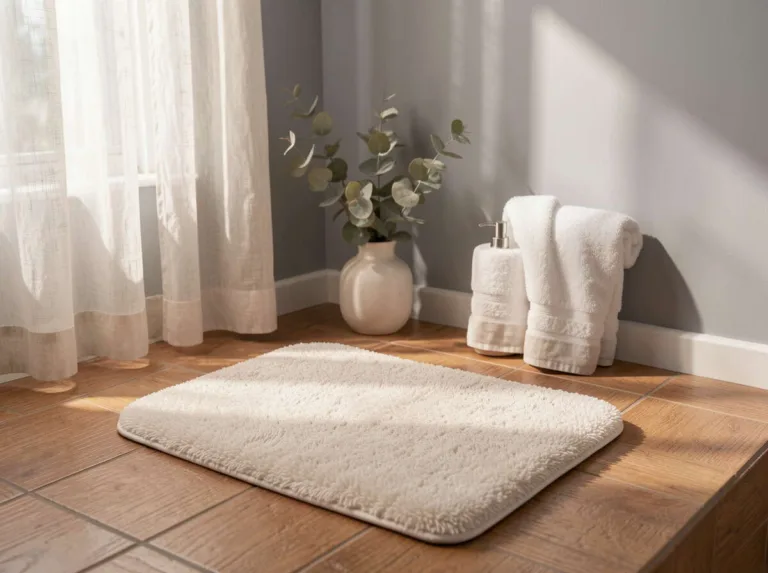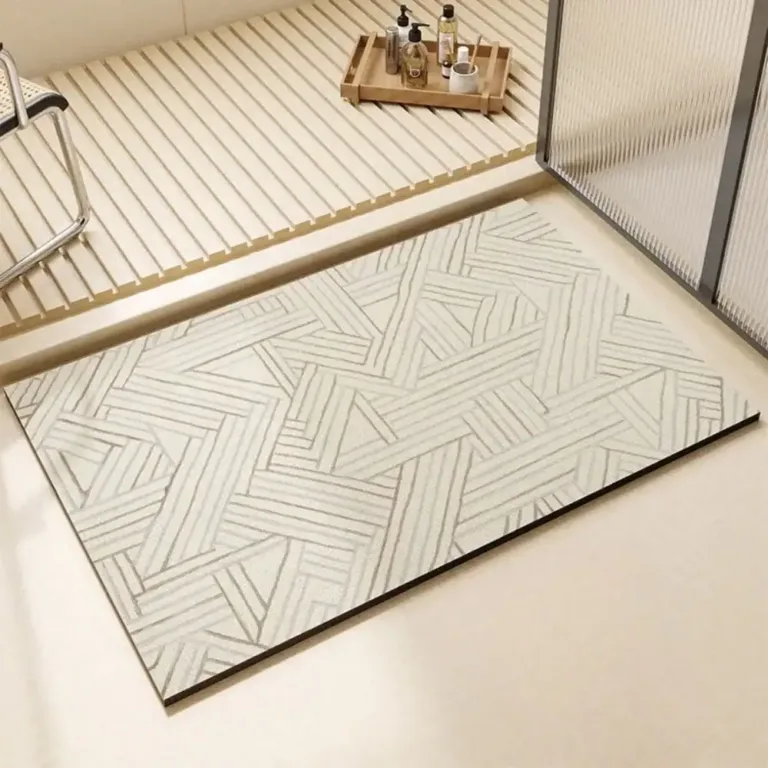
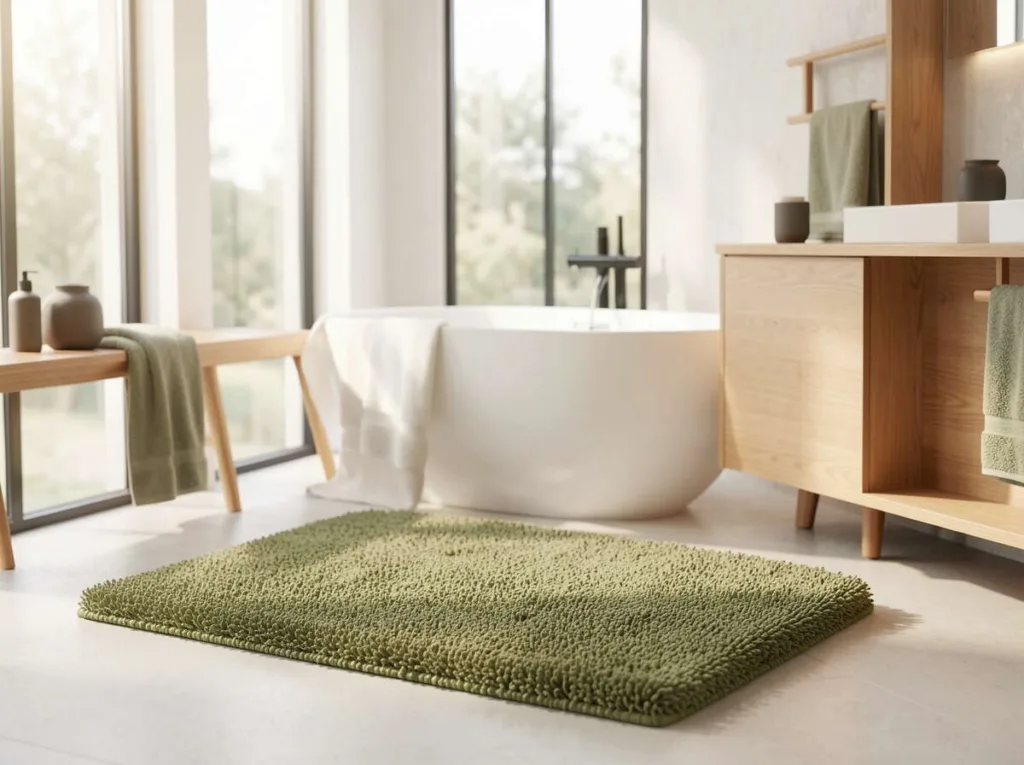
A heated bathroom floor and a bath mat seem like a natural pair. You step out of the shower onto something soft, and the tile around it stays warm. But a mat is also a layer sitting on top of the heat, and the companies that make in-floor heating systems have quite a lot to say about what you put on their floors.
This guide pulls together what the installation manuals of floor heating brands sold in Canada actually say about rugs and mats: thickness, rubber and foam backings, the floor temperature sensor and thermostat limits. It ends with a short section on stand-alone electric heated mats, the plug-in kind, and what Canadian safety bodies ask you to check before buying one.
One point before we start: every heating system is different. The manual for your own system always comes first, and the numbers below apply only to the products they were written for.
- 01Why a mat on a heated floor is not automatically a problem
- 02What the manufacturers say, brand by brand
- 03Quick comparison: what the manuals say about mats and rugs
- 04The floor sensor: the detail most people miss
- 05Maximum floor temperatures and your thermostat
- 06Choosing a bath mat for a heated floor
- 07Stand-alone electric heated mats
- 08Quick quiz: bath mats on a heated floor
- 09Checklist: bath mat on a heated bathroom floor
- 10Frequently asked questions
- 11Sources
Why a mat on a heated floor is not automatically a problem
Most floor heating makers do not ban rugs outright. The concern is heat that gets trapped under something that insulates.
The SunTouch TapeMat installation manual (Watts, 2021) puts it in balanced terms: “Most products are okay to use, but if in doubt, consult the product manufacturer for compatibility.” It then lists the exceptions, which we cover below.
For hydronic systems (warm water running through tubing in the floor), REHAU’s Canadian radiant heating FAQ says a rug is compatible with radiant floor heating, but that “a very thick rug can act as an insulator to the warmed floors, which can slow the response time of a radiant system.”
WarmlyYours explains the mechanism in its article on avoiding trapped heat with electric floor heating: items placed on top of the floor can trap radiant heat, and objects left in one spot for long periods can lead to localized discolouration of carpet or laminate.
So the real questions are how thick and how insulating your mat is, what its backing is made of, and where it sits in relation to the floor sensor.
What the manufacturers say, brand by brand
Nuheat
The Nuheat Mat Installation Guide (2025 edition) is one of the most direct documents on this subject. It tells you not to place objects directly on top of the floor “that could impede/trap heat emanating from the floor heating system including but not limited to flush-to-floor furniture, rubber or memory foam mats, and mattresses.”
The reason given is plain: these objects “could cause unsafe temperatures to be reached underneath these objects which may cause damage to the object and/or the flooring material.” The same warning appears in the Nuheat Cable Installation Guide.
The mat guide also caps the total combined R-value of all floor coverings at R-2.5, and it asks installers to place the floor sensor probe away from “areas covered by rugs or fixed furniture.”
Schluter DITRA-HEAT
The Schluter DITRA-HEAT Installation Handbook (04/2023) is the strictest of the manuals we reviewed. In its operating tips, it states that area rugs are not recommended over the DITRA-HEAT system, “but if used, they shall have an insulating R-value not greater than 1 (Rsi not greater than 0.18).”
It adds that rugs must not be placed on top of the spot where the floor temperature sensor is installed, and it says: “Do not place furniture or mats over the floor temperature sensor. They can act as insulation and raise the floor temperature reading at the thermostat.” According to Schluter, this can make the heating switch off before the rest of the floor reaches the desired temperature.
The handbook also says futons, mattresses, floor-level furniture and pillows must not be placed directly onto the heated floor, because they prevent heat diffusion and could result in damage.
SunTouch (Watts)
The SunTouch TapeMat installation manual asks you to take care with “area rugs, throw rugs, and other surface products” and gives two clear limits: “Do not use rubber backed products that may degrade or very heavy rugs that will trap heat.”
It also warns against placing a rug over the area where the sensor tip was installed, as this causes false thermostat readings. For furniture, it asks for an air clearance of at least 1 1/2 inches (about 3.8 cm).
Warmup
The Warmup StickyMat installation manual, which lists a Canadian helpline, says in its operating tips: “Avoid placing thick mats / rugs / floor level furniture etc, on your heated floor, specially in the area where the sensor of a floor-sensing thermostat is located.” According to Warmup, these items restrict heat transfer away from the cables, so the floor area beneath them ends up warmer than other areas.
WarmlyYours
In replies published under its article on avoiding trapped heat, WarmlyYours gives a simple rule of thumb: avoid rugs thicker than 3/4 inch (about 1.9 cm), since they act as an insulator over the heated area. On materials, its answer is that the higher the R-value of a material, the greater the chance it traps heat.
WarmlyYours also answered readers about yoga mats: as long as the mats are not left in place permanently, there should not be significant issues with trapped heat.
Hydronic systems
The hydronic guidance we found is less specific than the electric manuals. REHAU’s Canadian FAQ says plush carpeting “will significantly reduce heat transfer versus ceramic tile” and that a very thick rug slows the system’s response. It points readers to its design guide and a local contractor for numbers that fit a given floor. If your bathroom has hydronic heating, the installer or the system’s documentation is the place to confirm any limit.
Quick comparison: what the manuals say about mats and rugs
| What you put on the heated floor | What the manuals say | |—|—| | Rubber-backed mat or rug | SunTouch: do not use rubber backed products that may degrade. Nuheat: do not place rubber mats on the heated floor. | | Memory foam mat | Nuheat: listed among objects not to place on the heated floor. | | Thick or heavy rug | SunTouch: avoid very heavy rugs that trap heat. Warmup: avoid thick mats and rugs. WarmlyYours: avoid rugs thicker than 3/4 inch (1.9 cm). | | Any area rug over DITRA-HEAT | Schluter: not recommended; if used, R-value of 1 or less (RSI 0.18 or less). | | Mat or rug over the floor sensor | Schluter, SunTouch and Warmup: do not. Nuheat: install the sensor away from areas covered by rugs. | | Thick rug on a hydronic floor | REHAU: compatible, but a very thick rug can slow the system’s response. |
The floor sensor: the detail most people miss
Many floor heating thermostats read the temperature from a sensor buried in the floor, between the heating wires. That sensor is the reason the placement of your bath mat matters as much as its material.
If a mat sits on top of the sensor, it insulates that spot. According to Schluter, the thermostat then reads a higher temperature than the rest of the floor and can stop heating too early. SunTouch and WarmlyYours both describe this as a source of false readings.
A few practical steps follow from the manuals:
- Find out where the sensor is. SunTouch and Schluter recommend photographing the installation, and the sensor location is often marked in those photos or on the paperwork your installer left.
- Keep the bath mat off that spot. Nuheat’s guide asks installers to place the probe away from areas covered by rugs, so a well-planned installation may already have taken the usual mat position into account.
- If you are planning a renovation, tell your installer where you intend to put the bath mat so the sensor goes elsewhere.
Maximum floor temperatures and your thermostat
The manuals give temperature limits mostly to protect the floor covering itself, not the mat:
- The Schluter handbook says that when DITRA-HEAT is used under alternative floor coverings such as vinyl, laminate or engineered wood, the thermostat must be set at 28°C (82°F) or lower at all times, and the floor covering must withstand at least 29.5°C (85°F).
- The SunTouch manual notes that most laminate and wood floor manufacturers specify their flooring should not be subjected to temperatures over 27 to 28°C (82 to 84°F), and asks you to set the thermostat’s floor limit accordingly.
- The WarmlyYours TempZone custom mat manual says many laminate and engineered wood manufacturers recommend limiting the floor temperature to 28°C (82°F), and that its thermostats, using a floor sensor, provide this control.
None of these manuals sets a specific temperature limit for bath mats. What they do say is that trapped heat makes the area under an insulating object warmer than the rest of the floor (Warmup) and can reach unsafe temperatures under some objects (Nuheat). Keeping the thermostat at the setting recommended for your floor, and not over-insulating any part of it, follows the logic of these manuals.
Choosing a bath mat for a heated floor
No manual we reviewed names cotton, chenille, bamboo or any other mat material as approved or banned. Their guidance is about thickness, insulation and backing. Translated into buying criteria, that gives you a short checklist:
- Backing. Check whether the mat has a rubber, latex or foam backing. SunTouch says not to use rubber backed products, and Nuheat lists rubber and memory foam mats among objects not to place on the heated floor. If the product description does not say what the backing is made of, ask the seller.
- Thickness. WarmlyYours suggests avoiding rugs thicker than 3/4 inch (about 1.9 cm). On a DITRA-HEAT floor, Schluter goes further and does not recommend area rugs at all, with a maximum R-value of 1 if you use one.
- R-value. Few bath mats list an R-value. If yours does not, treat thickness and backing as your guide, or contact the floor heating manufacturer.
- Placement. Keep the mat away from the floor sensor, as Schluter, SunTouch and Warmup all ask.
- Time on the floor. WarmlyYours’ answer on yoga mats suggests that items not left in place permanently are less of a concern. Lifting or hanging a bath mat when it is not in use is a simple way to apply that idea, though no manual addresses bath mats specifically.
A thin textile mat without a rubber backing is the closest match to these criteria. If you are comparing options, the textile bath mats category lets you check materials and backings, and the wider bathroom mats range shows other styles. Whatever you choose, read the product details for the backing and thickness, and compare them with your heating system’s manual.
Stand-alone electric heated mats
The search term “heated floor mats for bathroom” also covers a different product: a portable electric mat that plugs into a wall outlet and warms by itself, with no in-floor system. These are electrical appliances, and the rules that matter are electrical safety rules.
Look for a Canadian certification mark
Health Canada’s guidance on buying electrical products online is direct: “Do not buy electrical products that plug into a power outlet without a Canadian electrical certification mark.” It gives CSA, cUL and cETL as examples, and says the mark must be on the product itself, not only on the packaging. If you cannot see it in an online listing, Health Canada advises asking the seller. It also recommends caution when buying electrical products from outside Canada, since they may not carry certification marks or meet Canadian requirements.
Provincial regulators say the same. Ontario’s Electrical Safety Authority (ESA) states that before an electrical product is used, sold, displayed or advertised for sale in Ontario, it must be approved by an accredited certification or evaluation agency, and it asks consumers to look for the mark or label before buying. Technical Safety BC notes that BC’s Electrical Safety Regulation requires electrical equipment to carry the mark of a certification agency accredited by the Standards Council of Canada, or a Technical Safety BC approval label.
Follow the manufacturer’s instructions and check recalls
Heated mats vary a lot in design, so use, placement and cleaning instructions come from the manufacturer’s manual, not from general advice. A few points from Canadian sources apply broadly:
- ESA advises against running cords under rugs, through doors or windows, or across walkways, and against overloading cords or circuits.
- Health Canada suggests checking the recalls database before buying a used product. Heating products used with rugs have been recalled in Canada before: in 2008, Health Canada posted a recall of Comfortplus under area rug warmers because the cord could come loose from the plug and cause sparks or flames.
- If you are considering a plug-in heated mat on top of an in-floor heating system, check with both manufacturers first. None of the manuals we reviewed addresses this combination directly, and they all warn about items that trap heat.
Quick quiz: bath mats on a heated floor
Click a question to see the answer.
1. Rubber-backed bath mat on floor heating: fine?
SunTouch’s instructions say not to use rubber-backed products that may degrade, and Nuheat’s guide advises against rubber and memory foam mats on a heated floor.
2. Can a mat sit over the floor sensor?
No. Schluter, SunTouch and Warmup all ask you not to cover the floor sensor, since it would skew the thermostat reading.
3. How thick can a rug be?
WarmlyYours advises avoiding rugs thicker than 3/4 in (1.9 cm), and Schluter sets a maximum of R1 (RSI 0.18) if a rug is used over DITRA-HEAT.
Checklist: bath mat on a heated bathroom floor
- I know which floor heating system I have and where its manual is.
- The mat does not cover the floor sensor.
- I avoid rubber-backed and memory foam mats, as the manuals advise.
- I pick a thin textile mat rather than a thick rug.
- An electric heated mat carries a CSA, cUL or cETL mark on the product itself.
Frequently asked questions
Can you put a bath mat on a heated bathroom floor?
Generally yes, with conditions. SunTouch says most surface products are fine, and REHAU says rugs are compatible with hydronic radiant floors. The exceptions are rubber-backed and memory foam mats (Nuheat, SunTouch), thick or heavy rugs (SunTouch, Warmup, WarmlyYours) and any mat over the floor sensor. Schluter does not recommend area rugs on DITRA-HEAT and sets a maximum R-value of 1 if you use one.
Are rubber-backed bath mats OK on heated floors?
Two manufacturers say no. The SunTouch TapeMat manual says not to use rubber backed products that may degrade, and the Nuheat installation guides list rubber mats among objects that should not be placed on the heated floor because they can trap heat.
How thick can a rug or bath mat be on a heated floor?
WarmlyYours suggests avoiding rugs thicker than 3/4 inch (about 1.9 cm). Schluter expresses its limit as insulation rather than thickness: an R-value of 1 or less (RSI 0.18 or less) for any rug used over DITRA-HEAT. Other manufacturers simply say to avoid thick or very heavy rugs, so check your own system’s manual.
Why should a mat not cover the floor sensor?
A mat over the sensor insulates it. According to Schluter, the thermostat then reads a higher temperature and may turn the heat off before the rest of the floor is warm. SunTouch calls this a false thermostat reading.
Can a memory foam bath mat damage a heated floor?
Nuheat’s installation guides list memory foam mats among objects that can trap heat and cause unsafe temperatures underneath, which may damage the object or the flooring. Nuheat advises not placing them on the heated floor.
What should you check before buying a plug-in heated mat in Canada?
Health Canada advises buying only plug-in electrical products that carry a Canadian certification mark such as CSA, cUL or cETL, on the product itself. Then follow the manufacturer’s instructions for placement and use, and check the Government of Canada recalls database for the model.
Sources
- Nuheat (Chemelex/nVent), Mat Installation Guide H59307, 2025
- Nuheat (Chemelex/nVent), Cable Installation Guide H59308, 2025
- Schluter Systems, Schluter-DITRA-HEAT Installation Handbook, 2023
- Watts / SunTouch, TapeMat Installation Manual (IOM-WR-TapeMat), 2021
- Warmup, StickyMat Matting System Installation Manual, 2015
- WarmlyYours, Avoiding Trapped Heat with an Electric Floor Heating System, 2013 (replies 2020-2023)
- WarmlyYours, TempZone Custom Mat Installation Manual, 2023
- REHAU Canada, Frequently Asked Questions: Radiant Heating
- Health Canada, Buying electrical products online, 2026
- Electrical Safety Authority (Ontario), Search for an Approval Mark
- Electrical Safety Authority (Ontario), Product Safety Tips for Consumers
- Technical Safety BC, Approved Certification Marks for Electrical Products (B-E3 071019 3), 2024
- Government of Canada Recalls and Safety Alerts, Comfortplus Under Area Rug Warmers recall, 2008

Simple guides to picking, styling and looking after bath mats.